
The Trails
A Reflection from Myrtle Beach

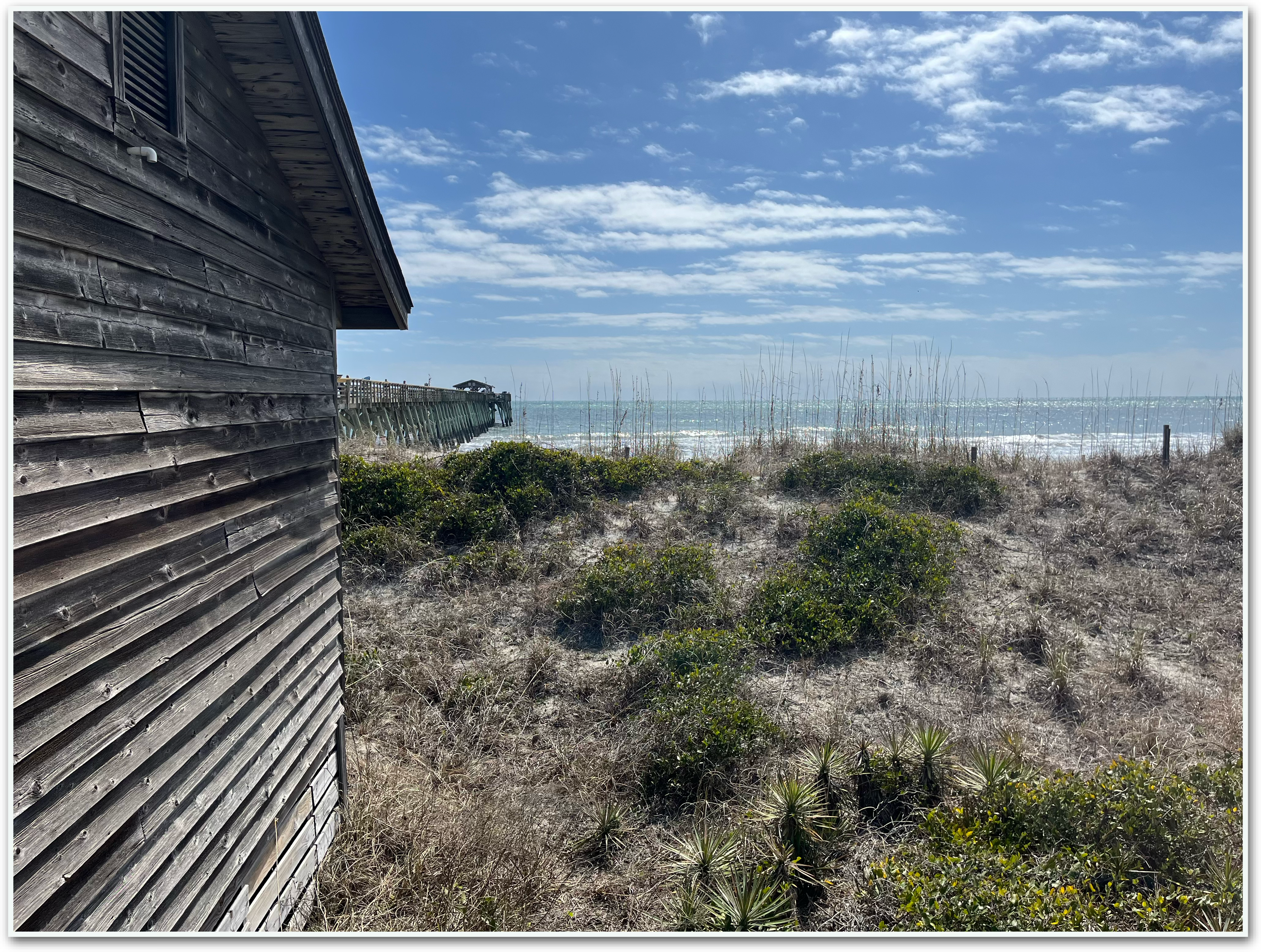
The wind was cold enough that day to make you grateful for anything that blocked it, so I stepped around to the south side of the store and stood there on the boardwalk in the shelter of the building. The sky was deeply blue, the sun was out, the pier stretched over the water on its wooden pylons the way it had for decades — and none of it mattered to the wind, which moved through the scene with complete indifference to how beautiful everything looked.
From the boardwalk, I found myself looking down into the dunes. The sea grass moved in long, slow waves, brown and green together, the way grass moves when it has learned to live with the wind rather than resist it. The sand between the clumps held the particular stillness of a place that doesn’t get much foot traffic. And then I noticed the trails.
Narrow paths pressed into the grass and sand, curving between the dune rises in the unhurried way of something that knew exactly where it was going. Not human paths — too narrow, too low, following the logic of the terrain rather than the convenience of whoever was moving through it. Something came here. Something moved through this grass regularly enough to leave its mark. I looked at the pictures on the side of the building — the wildlife of the state park identified and named, fox and raccoon and marsh rabbit, the nighttime residents of a place that belonged to them long before it belonged to us.
I hadn’t seen any of them. I wouldn’t see any of them. They moved through this landscape in the hours I was not here, and the only evidence of their existence was pressed into the grass below my feet, standing on the boardwalk.
I stood there for a while thinking about the evidence.
There were other signs of presence in the scene. A candy wrapper half-buried in the sand near the dune base. An empty soda can caught against a clump of grass. Human evidence — bright, obvious, impossible to miss, and impossible to mistake. The kind of evidence that announces itself the way a wave does, that requires no interpretation, that simply declares: someone was here, someone was careless, here is the proof.
The animal trails required something different. Not more intelligence, exactly. More stillness. More willingness to look at something subtle and allow it to mean something, to let the pressed grass tell you about a living thing you would never see directly.
I have been thinking about this in relation to truth — what it is, where it lives, how we recognize it. We have come to believe, in the last few centuries, that the candy wrapper is the standard. Bright. Verifiable. Empirically present. Show me the evidence, and I will believe you. If you cannot show me the evidence, the thing does not exist, or does not matter, or cannot be trusted.
It is a reasonable standard for candy wrappers. I don't think it is the right standard for animal trails.
The Bible has been caught in this argument for longer than it deserves. People defend it by saying it is historically reliable, archaeologically supported, empirically verified, where verification is possible — as if the truth it carries would be diminished if the dates were wrong, or confirmed if they were right. As if the thing it is trying to say is the kind of thing that can be settled by evidence of that kind.
But the Bible is not a candy wrapper. It is not trying to leave bright, obvious proof of its own presence. It is attempting something far more difficult — to describe the deep trails in the grass, the paths pressed into the world by something that moves through it in the hours when our instruments are not running, in the registers our instruments were not built to detect. It uses theological language the way physics uses mathematics — not because the equations are the universe, but because they are the best available path toward something almost too large to approach. The map is not the territory. The theology is not God. Both are human attempts to follow a trail left by something that will not sit still long enough to be photographed.
A physicist does not say the universe is false because it contains phenomena that current equations cannot explain. The mystery is not a defect. It is information about the size of the thing.
The weathered boards of the building. The pier on its pylons, standing in the tide without argument. The grass moving in the wind against that deep blue sky. The trails in the sand leading somewhere I would not follow, left by something I would not see.
The evidence was everywhere. It just required a different kind of looking.